Reflecting on our Past, Committing to Our Future
Australia’s national days invite us to pause — to reflect on who we are, where we have come from, and who we aspire to be as a nation. Days such as Australia Day and the anniversary of the National Apology to the Stolen Generations offer important opportunities to acknowledge our shared and complex history, and to recommit to a future grounded in truth, respect and unity.
Acknowledging the past
The National Apology to the Stolen Generations was a significant moment of national truth telling. It acknowledged the profound pain, trauma and loss caused by past government policies of forced child removal and assimilation and honoured the strength and resilience of Aboriginal and Torres Strait Islander peoples.
Across Australia, the stories are heartbreakingly similar: children removed from their families by governments and missionaries; placed in institutions or adopted by white families; often used as cheap labour; and families living in constant fear of their children being taken.
Acknowledging this history is essential. It is about honouring those who lived through these policies and ensuring their stories are never forgotten.
Understanding the present
The journey to the National Apology was shaped by the Bringing Them Home report [1], a landmark inquiry that exposed the scale and impact of the injustices experienced by the Stolen Generations. While the Apology represented an important commitment, the work it called for remains unfinished.
Many of the report’s recommendations are yet to be fully or consistently implemented, and our systems still fall short of providing the conditions needed for a prosperous future for all First Nations peoples.
The Federal Government’s Closing the Gap dashboard [2] shows that nationally in 2023, 43.7% of children aged 0-17 years in out-of-home care were Aboriginal and Torres Strait Islanders. This was an increase of 3.7 percentage points since 2019. An Aboriginal or Torres Strait Islander child is 10 times more likely to be removed compared to the general population. The trend of ‘adult crime, adult time’ policies is a step backwards, ignoring the evidence from experts who are clear that such policies are ineffective in reducing crime.
The ongoing over representation of Aboriginal and Torres Strait Islander children in out of home care, and the persistence of policies that ignore evidence and human rights standards, demonstrate that reconciliation requires more than words.
Understanding these realities reminds us that healing and justice demand sustained action, accountability and courage.
Reflecting on Australia Day
Australia Day is often described as a time for celebration, reflection and unity. Holding these ideas together honestly requires us to reflect on our complete history — including its discomforts as well as its achievements.
On our national day we can reflect on our complete and complex history and understand that acknowledging and reconciling our past helps lay a path to a stronger future. We respect and celebrate Aboriginal and Torres Strait Islander Peoples’ survival, resilience and over 65,000 years of continuous culture.[3]
There is an undeniable tension in celebrating 65,000 years of continuous Aboriginal and Torres Strait Islander cultures on a day that marks the arrival of the First Fleet in Warrane (Sydney Cove) and the beginning of colonisation on Gadigal Country. This juxtaposition invites deeper reflection — not defensiveness or denial, but honesty.
As Oodgeroo Noonuccal reminds us [4]:
“Let no one say the past is dead, the past is all about us and within.”
If we are to come together as a nation and build an inclusive and respectful future, we must go beyond surface level acknowledgement and commit to truth telling about our history and its ongoing impacts.
Listening to history, learning for the future
Reconciliation calls on all Australians to step forward together, guided by the lessons of the past as we shape what comes next.
Every Australian has a responsibility to understand the true history of this country, as well as the depth, sophistication and beauty of Aboriginal and Torres Strait Islander cultures and knowledge systems. Schools play a critical role in this work. Educators are central to truth telling, challenging deficit narratives, and teaching honest, unbiased accounts of Australia’s histories.
Listening to and understanding First Nations histories fosters respect, empathy and healing.
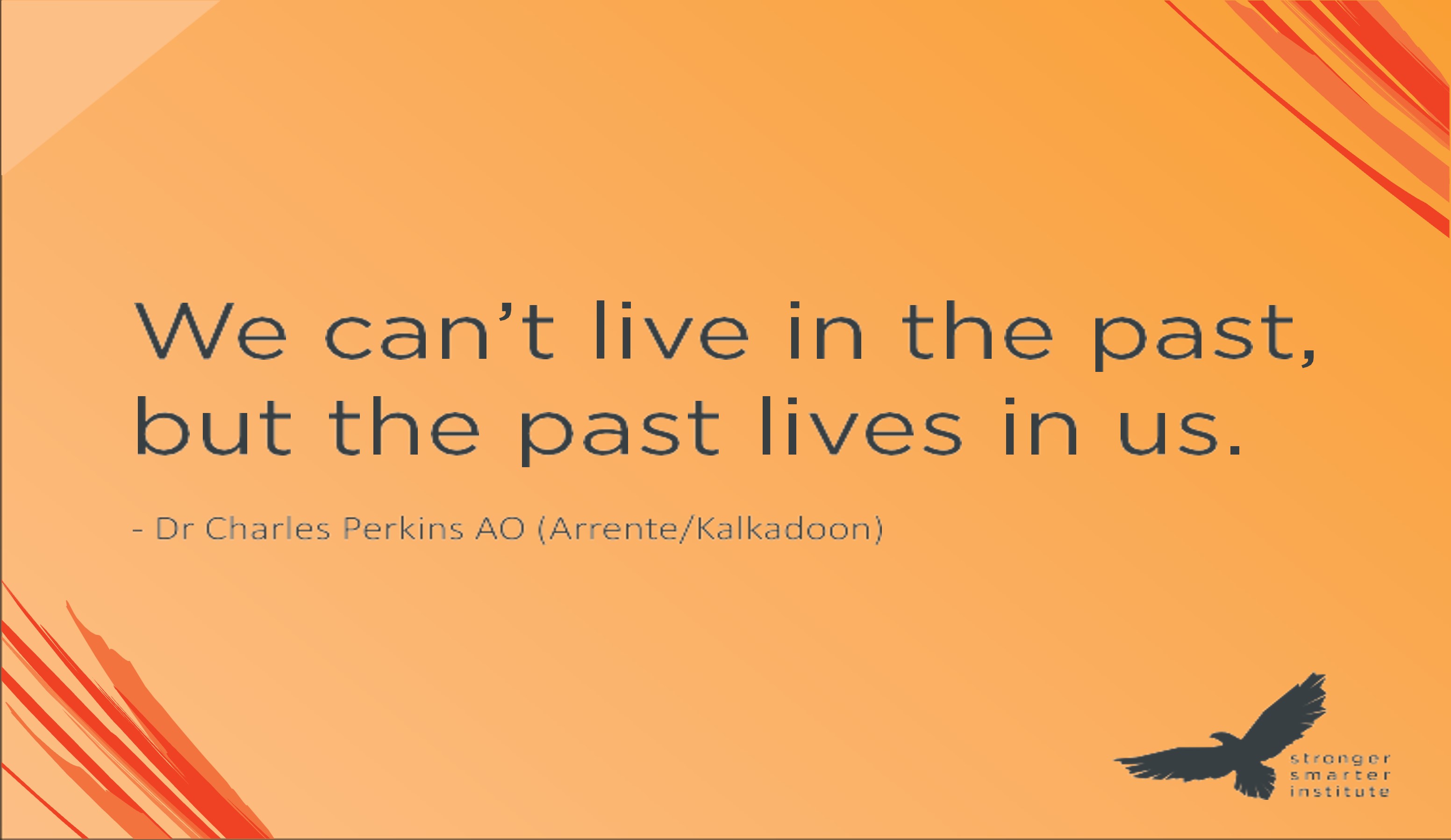
As Charles Perkins said:
“We cannot live in the past, but the past lives in us.” [5]
Valuing Indigenous Knowledges
Learning about Indigenous Knowledges is also central to creating a shared future where all Australians feel valued and included. Indigenous Knowledges encompass deep wisdom about the environment, science, medicine, art and community — refined over thousands of generations.
At the Stronger Smarter Institute, we seek to forefront Indigenous Knowledges and worldviews that emphasise connectedness, responsibility and relationality. These perspectives offer powerful insights, particularly in areas such as environmental sustainability and STEM education, where weaving together knowledge systems can enrich understanding and spark innovation.
Valuing Indigenous Knowledges empowers us to challenge stereotypes, address injustice and imagine new possibilities for the future.

Moving forward together
At the Stronger Smarter Institute, we remain committed to being at the forefront of this journey. Through our Stronger Smarter programs, we continue to support educators and communities to create transformative change in Aboriginal and Torres Strait Islander educational outcomes.
Our work centres High-Expectations Relationships, fosters pride in culture, and promotes excellence in schools — always with the goal of creating learning environments where every child can thrive as the strongest, smartest and most authentic version of themselves.
What you can do
- Educate yourself: Seek out resources created or endorsed by First Nations people, particularly from your local area. Critically reflect on your own positionality and the resources you use.
- Engage with Stronger Smarter: Attend a Stronger Smarter program or explore our online learning modules.
- Listen and learn: Take time to listen to First Nations voices, stories and experiences, and engage respectfully with community events and initiatives.
- Support our work: Consider supporting the Stronger Smarter Institute as we continue to advocate for educational excellence, justice and opportunity.
As we reflect on Australia Day and honour the anniversary of the National Apology, let us commit to learning, listening and moving forward together.
By embracing truth, valuing Indigenous Knowledges and acting with integrity, we can build a more inclusive, respectful and united Australia — for the benefit of all.
Through our Stronger Smarter programs, we continue to empower educators and communities to create transformative change in Aboriginal and Torres Strait Islander educational outcomes. We continue to emphasise High Expectations Relationships, foster a sense of pride in culture and promote excellence in schools. We continue to work for a future where every child thrives in a Stronger Smarter classroom.
Let’s keep moving forward together, with respect, truth, and unity.
A few resources
Books
- Pascoe, B. (2014). Dark Emu. Magabala Books
- Steffensen, V. (2020). Fire Country: How Indigenous Fire Management Could Help Save Australia. Hardie Grant Explore.
- Sveiby, K-E & Skuthorpe, T. (2006). Treading Lightly: The hidden wisdom of the world’s oldest people. Allen & Unwin
- Davis, J. (2024). Strength Basing, Empowering and Regenerating Indigenous Knowledge Education: Riteway Flows. Routledge.
Online Resources
- AIATSIS Guide to evaluating and selecting education resources
- AIATSIS Curriculum Resources
- Mathematics Hub – resources (developed by the Stronger Smarter Institute) to inspire teachers of mathematics to see the connections between mathematics and First Nations peoples’ historied and cultures.
- The Narragunnawali program has tools and resources for schools and early learning services to take action towards reconciliation between non-First Nations Australians and Aboriginal and Torres Strait Islander peoples.
- Curriculum Resources from Ngarrngga – resources made in collaboration with Indigenous Knowledge experts
- CSIRO – an eLearning course designed to guide educators in building inclusive learning environments through cultural awareness and community engagement.
- Australian Curriculum – Science Elaborations addressing Aboriginal and Torres Strait Islander Histories and Cultures.
Join us for a program!
Our program calendar is now open. If you haven’t already undertaken our Stronger Smarter Leadership Program, make sure you join us this year.
Donate Now!
Donate Now to help us develop new and innovative programs and continue to advocate for change to support First Nations students across the country.
Footnotes:
[1] Bringing them Home Report recommendations.
[2] Closing the Gap dashboard – out of home care
[3] https://www.australiaday.org.au/about
[4] https://charlie.csu.edu.au/2020/07/30/poets-of-australia-1-oodgeroo-of-the-noonuccal/
[5] https://www.abc.net.au/news/2019-11-16/boyer-lecture-rachel-perkins-echoes-uluru-statement/11696504