Stronger Smarter Together: Relational Sovereignty in a Modern Australia
The world seems a bit crazy right now. Global politics is unsettled and leadership in many places seems fragile. Conflict, division and cultural anxiety can travel quickly across borders. Even from a distance, it can feel as though we are caught inside a restless, yet inescapable geopolitical ecosystem.
Such instability does something to us. It unsettles us. It sharpens our sense of vulnerability. It can cause us to feel threatened by the unfamiliar.
It brings a choice before us.
Not a party-political choice. Not even a policy choice. A deeper choice; one in which we must contemplate who we are and who we want to be.
From time-to-time voices emerge in our public life that invite us as Australians to look at one another and ask: Who belongs? Who looks like ‘us’? Who feels culturally familiar? Often these invitations are framed as common sense, presented as concern and sometimes defended as realism.
Amidst such framing lurks something more sinister and far more consequential. It asks us to narrow the circle of belonging.
This invokes a test of our character.
I have always been inspired and influenced by the philosophical concept of the Concrete Universal. It might sound abstract but it is deeply practical. It lets us understand that the strongest form of unity is not in sameness. It is not about everyone blending into one colour or one story. It is many different lives, histories and identities choosing to stand inside a shared moral space.
Australia at its most thriving and vibrant best is exactly that.
We are not confident and cohesive because we look the same, worship the same, or descend from the same ancestral line. We are confident and cohesive because when it matters, we act as if every person standing beside us matters.
When crisis strikes, we see this, and it is palpable.
After the 2013 floods devastated my hometown of Bundaberg, I stood overwhelmed at our family home after it had been smashed and swallowed by water. My brother and I stood helplessly, unsure and wondering what to do next. I was even more overwhelmed by what happened next. People just turned up. Without being asked and without checking who we were. Without running some mental calculation about whether we looked like them, voted like them, or even prayed like them. They came with shovels, with food, and with quiet determination to help us in an hour of need.
That reflex – that instinct to just show up – is Australia at its most thriving and vibrant best.
During the Bondi attack, amidst horror and chaos, an Australian Muslim citizen of Syrian origin ran toward danger to disarm an attacker. At the same time Bondi Life Savers ran to victims with their AED because they knew they would be required. No hesitation. No calculation about optics. Just courage.
We all see it during bushfires and floods when Sikh Australian volunteers and Turbans 4 Australia take to long highways to cook meals and feed Australians they have never met. They do not ask about religion or background before serving. They simply act.
In these moments, something deeper than difference surfaces.
Not ethnicity. Not creed. Not cultural nostalgia.
In these moments it is our character that is exposed.
It is worth contemplating why such character can shine so clearly in a time of crisis yet become so clouded when times are calm. Why a street filled with diverse faces can unsettle some of us, yet a disaster filled with diverse heroes can rightfully fill us with pride.
Like any other humans on the planet, we are naturally wired to notice differences and feel fear. Familiarity feels safe.
Our humanity and character however is not built on instinct alone. It is built on aspiration. Being a bloody good Australian is always an aspiration – not a complexion. It can never be reducible to colour, surname or religious labels.
We value fairness, even when it costs us. We value straight talk, even when it is uncomfortable. We value giving someone a go, even when they are new. We value showing up, especially when it matters.
It would be naïve to pretend we have always extended these values evenly. The experience of many First Nations Australians reminds us that our national story includes moments where such values have fallen short. This is not an argument against our values; it is a gentle and respectful challenge to live them more fully and more consistently.
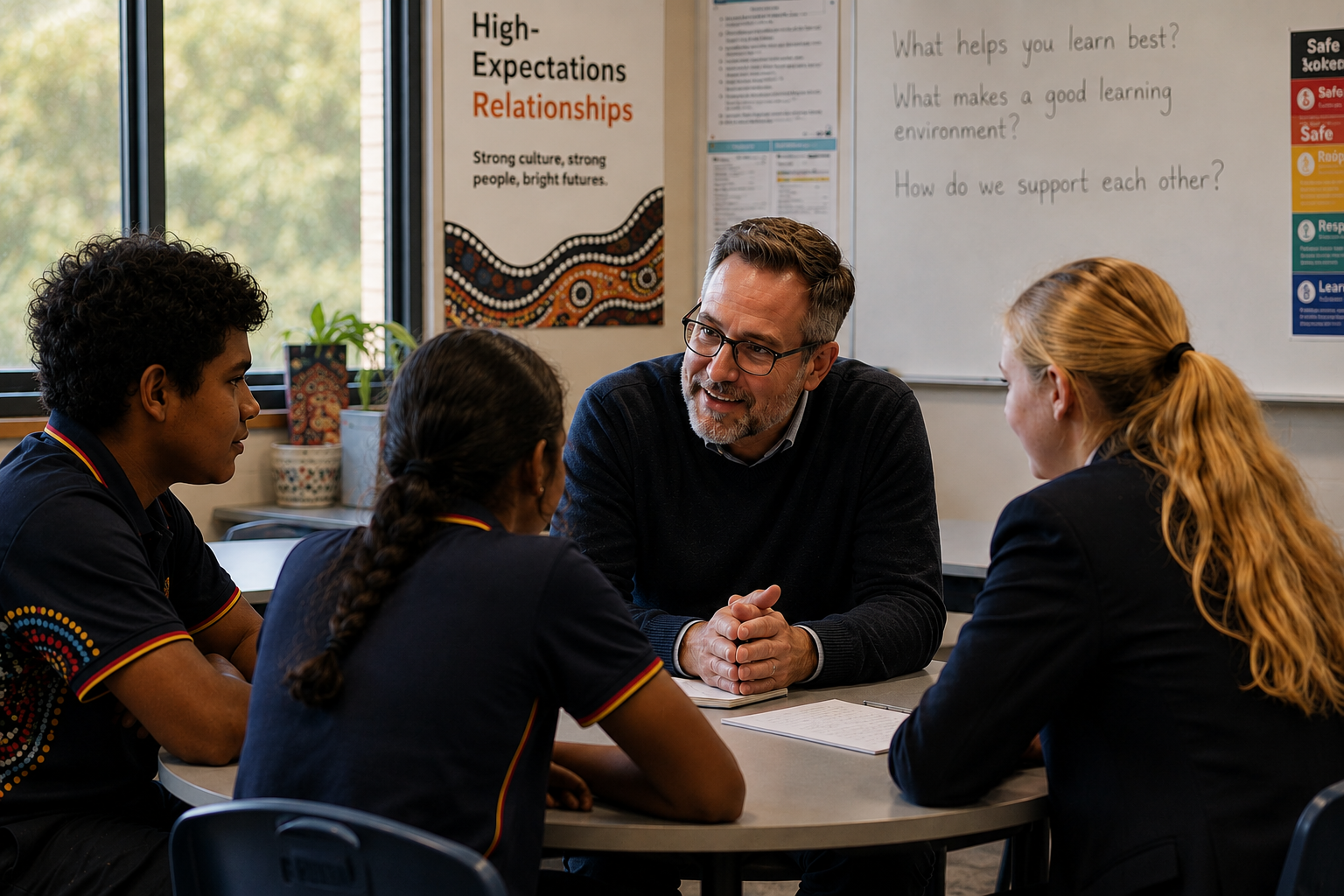
These values and behaviours are not inherited through bloodlines. They are lived into. They are practised. They are reinforced in a high expectations relationship.
If we shrink ‘Australian Culture’ to appearance or ancestry, we betray the honourable core of our character. We shift from asking, How do we treat one another? To asking, Who looks like they belong?
We are all diminished by this shift, so together lets contemplate another way to think about ‘belonging’ in Australia.
Relational sovereignty is not about who dominates whom. It is about the quality of the relationships we choose to cultivate. It insists on dignity, contribution and mutual respect. It rejects both resentment and naivety. It asks not ‘Who looks like us?’ but ‘How do we stand with one another at a higher standard?’
Some Australians may feel there are legitimate concerns about migration, integration or social cohesion. These are conversations worth having. Let us have them with evidence, seriousness and good faith.
In such conversations it is worth understanding the profound difference between debating sensible policy and demeaning people.
One approach strengthens a democracy; the other contaminates it.
When public rhetoric drifts into ‘dog-whistling’ – subtle signals that some Australians are less authentically ‘us’, that some belong on probation, that some must forever be outsiders – it does more than provoke headlines and clicks online. It legitimises suspicion and stokes the acrid embers of resentment. It nurtures and colludes with a lesser version of us.
When we undermine the humanity of others, we undermine and stifle our own humanity.
The moment we cast entire groups as suspect, or lesser than, because they look or pray differently, we contaminate the relationships that hold a nation together. That contamination stifles trust; and without trust, the notion of a positive and vibrant future is lost to all of us.
The question before us is simple: Which Australia do we want to cultivate?
Is it the anxious one that scans a crowd for difference or sameness? Or is it the confident one that knows character and identity run deeper than skin, suburb or surname?
We cannot be both anxious and confident at the same time. We must be clear about what instincts we cultivate.
A mature and self-assured Australia doesn’t need to pretend that differences do not exist. Differences are real. Integration takes work. Social cohesion requires effort, trust and respect. Cohesion grows from confidence, not from anxiety.
A confident and principled nation doesn’t narrow the circle of belonging to feel secure. It raises expectations of others and seeks to embrace others at a higher standard. It insists on contribution. It expects mutual respect.
It refuses to define itself by fear.
We know this Australia because we see it in our times of need. We have seen strangers pull strangers from floodwaters. We have seen neighbours rebuild homes not their own. We have seen people of every background act with extraordinary courage when it counted.
This does not reflect weakness. This reflects strength.
Australia is capable of better. Not because we are flawless, but because, at our best, we rise above our worst traits. We choose aspiration over anxiety and mistrust. We choose character over caricature
Let us be this Australia – not only in crisis, but in calm. Not only when the water rises, but when the distasteful rhetoric does.
When we honour and embrace the humanity of others, especially those who are different; we do not lose ourselves, we become the best version of ourselves.
We become a more vibrant and thriving version of ourselves; not a nation that yearns for the past, but rather a more authentic and honourable Australia that can stride confidently into the future.
Dr Chris Sarra
CEO, Stronger Smarter Institute