

The Start of the Relationship
My last article talked about the art of the relationship; in this article let’s consider the start of the relationship. I recounted a time in a room full of Directors-General discussing ‘Closing the Gap’ when I said: ‘You know most blackfullas aren’t even talking about ‘Closing the Gap’?
Yes, it did catch them off guard and yes nobody asked, ‘So what are they talking about?’
It is a question that still lingers.
Away from the invisible power of the flash offices, policy rooms and official frameworks, most blackfullas are not sitting around talking about closing gaps. We are talking about our children, our families and our communities. We are talking about our culture, our country, our identity and the future. We are talking about how to be at our best, not how to be measured against someone else’s baseline.
There is a deeper issue here.
Much of First Nations policy in Australia continues to begin from a position of deficit.
That starting point matters more than we realise.
‘Closing the Gap’ is, on the surface, a reasonable ambition. Of course we want better outcomes in health, education, employment and safety. That is not in dispute.
The framing, however, is deeply problematic.
When you begin by defining a people through what they lack, you shape the entire relationship that follows. Deficit framing does not simply describe conditions. It quietly signals that Aboriginal people are a problem to be fixed, a population to be brought into line, a gap to be closed.
This is no way to start a relationship.
People do not build trust around framing that diminishes them.
Over time, something more subtle begins to happen. We all start to collude with that framing.
Deficit thinking is not sustained by government alone. It becomes embedded across systems, institutions and, at times, within our own communities. Expectations are lowered. Possibilities are narrowed. Conversations become predictable. Our belief in potential fades.
Government talks about gaps. Communities respond to the terms set for them. Individuals begin to internalise what is expected. Before long we are all participating, often unconsciously, in a diminished view of what is possible.
This is the real contamination.
Not simply that the framing is wrong, but that tragically it becomes normal.
I know first-hand what happens when the relationship begins differently.
On my very first school assembly with students at Cherbourg School, I said this.
‘The most important thing that you will learn from me is that you can be Aboriginal and you can be successful!’
From here we moved on to talk every day in every classroom about what it meant to be strong and smart. This was not a slogan; it was a statement of belief.
It was a deliberate and different starting point to my relationship with them, their families and their community. What followed was not accidental.
Enrolments went from 85 to 165; attendance lifted from 62 to 94 percent; literacy and numeracy results improved dramatically. Students were loving coming to school, and I was loving being there for them.
Something deeper was shifting. Adults and children were responding to the prospect of excellence and hope.
When the relationship starts with belief, with hope and the expectation that we can be at our best, people respond differently. They lift. They lean in. They begin to see themselves and others in a different light.
This is not soft work.
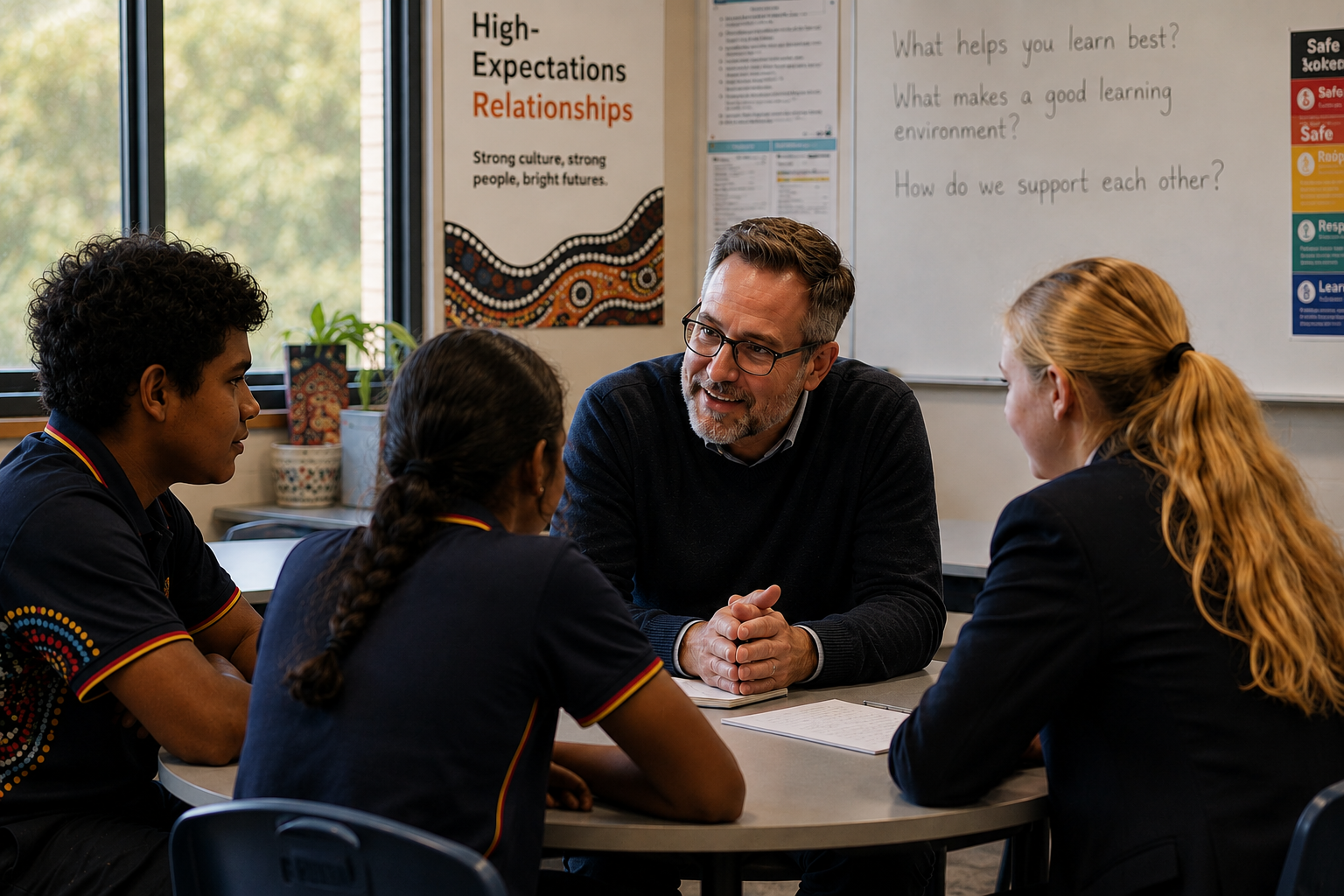
It requires discipline, consistency and above all, belief. It requires leadership that is committed to a High-Expectations Relationship and to use authority to enable others to rise.
The question is never whether power exists. The question is how it is used.
Power can be used to manage people through deficit. It can also be used to create the conditions in which people can be at their very best.
I will always choose the latter!
Years ago, when Malcolm Turnbull was the Prime Minister, he asked me a simple question. “Chris, what are three things we can do to make a difference in First Nations policy?’
I reflected upon what blackfullas are actually talking about and offered a simple proposition.
Embrace our humanity and our capacity to be exceptional.
Bring policy approaches that nurture hope rather than entrench despair.
Do things with us; not to us.
This is not abstract theory. It is grounded in practice.
We see elements of this in approaches such as Caring for Country programs that engage people through purpose, responsibility and cultural strength. We see it in the Indigenous Marathon Runners program, the NRL, and the Stronger Smarter Approach where High-Expectations Relationships and belief in young people change the trajectory of their lives.
Such programs engage us in ways that respect our agency, our authority and our identity. They are different because they start from a place of dignity, not deficit.
When the starting point of the relationship changes, what becomes possible also changes.
I saw this transformational change not only in students but in community.
Back in Cherbourg there is a guy named Frank Malone. He was working on a ‘work-for-the-dole’ scheme when I asked him to come and work with me as a teacher aide in the school. I was confident asking him because he cared deeply about his community and his love for the children of Cherbourg was profound. With support he worked as a teacher aide and completed remote teacher training.
Just last year I got a text from Frank.
‘On this day 25 years ago, I started work with you as a teacher aide here at Cherbourg State School. Today I am still here, and I am the Co-Principal.’
This is what happens when blackfullas are seen for who they can be, and not for what they lack.
Perhaps the issue is not simply the condition of Aboriginal communities; perhaps the issue lies in how we have come to think about them.
When that is the starting point, the relationship is already compromised.
If we are serious about a different future, then we must be prepared to start differently.
Relationships that begin in deficit rarely produce excellence.
Relationships that begin in belief, in hope and within High-Expectations Relationships have the capacity to reveal it.
Dr Chris Sarra
CEO, Stronger Smarter Institute
Excellent content here. The way you explained everything makes it easy to understand. Keep up the good work! (ref:728bb8d315f0)
Inspiring start to the relationship journey—pair that community‑driven mindset with the structured‑thinking approach from Telkom University Jakarta.